
Summary
Introduction – Rebuilding Knossos
Sir Arthur Evans dug up Knossos, then rebuilt it to fit his own story. Why the stories investors tell can be just as hard to see past.
Market Commentary - The Cost of Everything
From the gas pump to the grocery store to the fertilizer in the field: why inflation may be here to stay, and what it means for savers, consumers and business models.Portfolio Review
A review of key portfolio changes during the quarter, including new investments, trims, and exits.Performance Review
An overview of the companies that most influenced portfolio performance this quarter, both positively and negatively.Feature – Metatek-Group
Bringing what lies underground into view: how a small UK firm with Lockheed Martin technology and a decade-long head start became a partner to governments searching for energy and critical minerals.Factsheet
A concise snapshot of the portfolio, including sector exposure, top holdings, and historical performance.
Introduction
Rebuilding Knossos
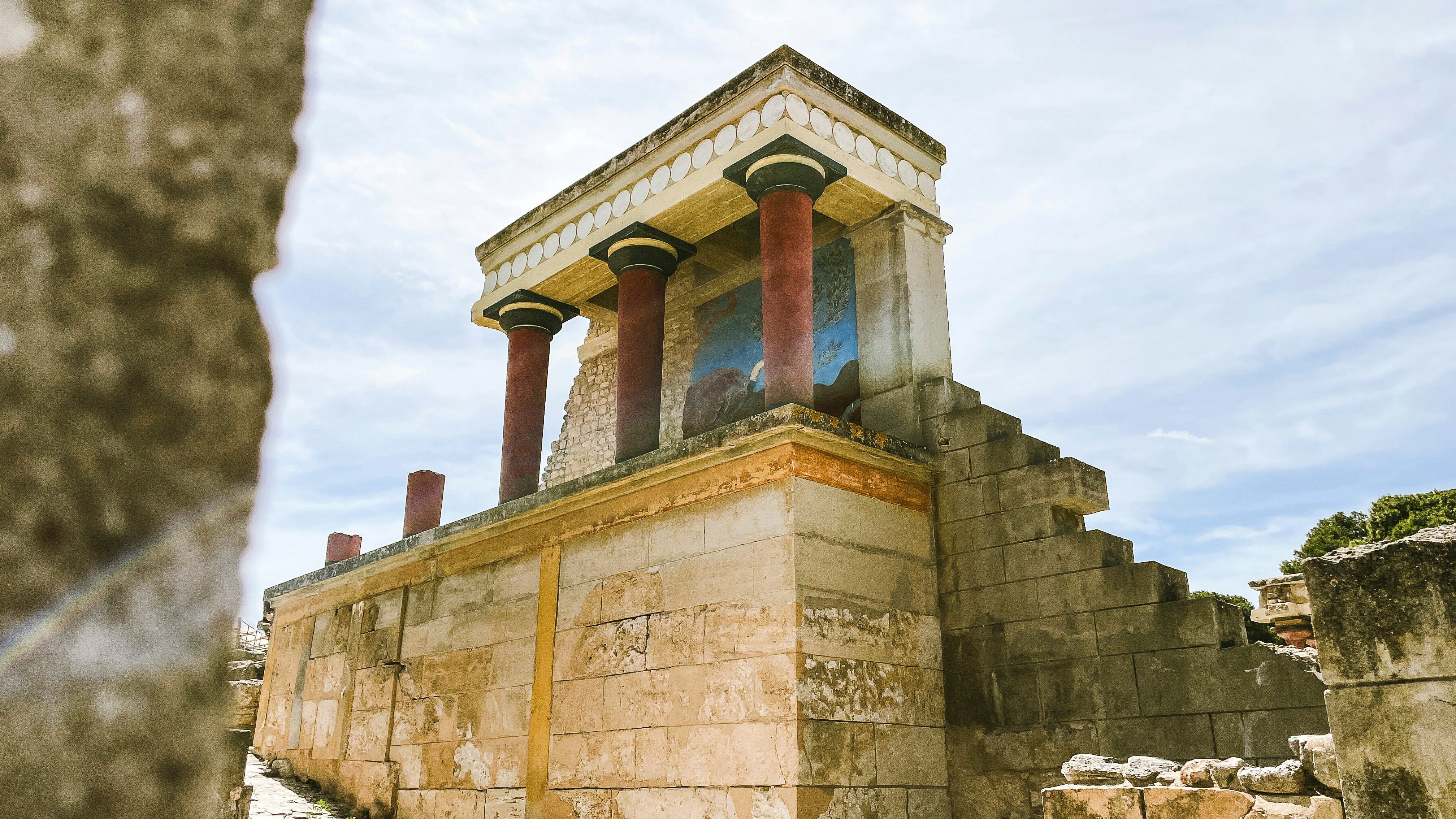
On a recent trip to Crete, I returned with a friend to the Palace of Knossos, the centre of the Minoan civilization that flourished there nearly 4,000 years ago and is often described as Europe’s first advanced society. Visiting in the off-season, without the crush of cruise ship and bus tour crowds, I noticed something I had largely overlooked the first time: how much of what we were looking at was not ancient at all.
When Sir Arthur Evans excavated the site in the early 1900s, he went further than digging. He rebuilt parts of the palace in reinforced concrete and repainted its frescoes to match his own idea of the Minoans. Upper storeys, painted columns and entire rooms were reconstructed in reinforced concrete, and many of the celebrated frescoes were pieced together from fragments, with the gaps filled in by artists working to his vision. Evans told a compelling story about who the Minoans were. A century later, his interpretation is what most visitors photograph, and the impression most of them take home.
Investing can be much the same. We are often presented with a compelling story built on fragments of evidence, with the gaps filled in by narrative. Over time, that narrative hardens, and it becomes difficult to see past it.
Today’s era may well be defined by artificial intelligence. Its effects on business and society are difficult to predict, but the capital behind it is real and is being deployed at historic levels. There are clear parallels to the internet boom of 1999 and 2000. The lesson we take from that period is that the internet was every bit as important as promised. The destination was right. What proved far harder to judge was the timing, where capital should be allocated, and who would ultimately capture the value.
Today, investors are telling themselves stories about who will win the AI race. The honest answer is that nobody knows yet. Every cycle is different, yet some patterns repeat. There is bound to be overbuilding in certain areas, much like the long-haul fibre of the early 2000s, when capital flooded the sector. Equally, there are likely to be overlooked areas that ultimately benefit, much as neglected “old economy” real assets did in the years that followed.
While others build the façade of the AI palace, we remain cautious and are finding opportunities in other areas. We look at the evidence: the financial statements, management’s track record and the incentives that drive behaviour.
I am also reminded of the value of a second visit. Returning years later, without the crowds, I saw the site more clearly and from a different perspective. When something is new and everyone is caught up in the moment, it is easy to be carried along by the story. Narratives are a shortcut our brains use to make sense of a complex world, and they have their place. In investing, however, a good story is no substitute for a sound process. Ours keeps us focused on what is real, and on situations where the evidence is strong enough to form an informed view.
At times, this means our portfolios will look out of step with the prevailing story. That is by design. Evidence tends to build slowly, long before it becomes a popular narrative. We would rather own businesses during that early stage, and be patient, than buy into a story once it is crowded and fully priced.
-Robert
Market Commentary
The Cost of Everything
This year, the cost of almost everything that comes out of the ground has gone up, and not just energy. Industrial metals such as copper (+16%), tin (+32%) and zinc (+27%) have all moved higher. So have the inputs that feed the food supply: soybeans are up 24%, corn 12% and urea fertilizer 21%.
Reported inflation tells a more measured story, at least for now. Canada’s Consumer Price Index rose 3.1% in the year to September, and U.S. consumer prices rose 3.7%. Strip out the most volatile items, however, and the picture is calmer. The Bank of Canada’s preferred core measures, CPI-trim and CPI-median, were 1.8% and 1.9%, while U.S. core inflation was 2.6%. The pressure, so far, is concentrated in fuel. Canadian gasoline prices were up 28% from a year earlier.
That gap between headline and core inflation is where our attention is. Higher costs for fuel, metals and fertilizer eventually make their way into the wider economy. They move through freight, manufacturing and grocery shelves with a lag, and we suspect much of that pass-through is still ahead of us. The Bank of Canada appears to share the concern. On October 28, it raised its policy rate to 2.50%, its first increase since 2023, citing the risk that high energy prices spread to the prices of other goods and services.
The Hidden Tax
Inflation is often called a hidden tax, and savers feel it first. At 3% inflation, a dollar loses about a quarter of its purchasing power in ten years. At that pace, prices double in roughly 24 years. Today, savers face a second problem. With the policy rate at 2.50% and inflation at 3.1%, money held in cash or short-term deposits is losing ground, even before taxes are considered.
Inflation is also a matter of perception, and that impacts how people spend. The prices at the pump and the grocery store, are the ones that shape how they feel about their finances. When those prices rise faster than paycheques, confidence erodes even if the official numbers look manageable.
Consumers respond the way you would expect. They trade down, delay larger purchases and become more sensitive to price. Businesses can feel this change happening well before it shows up in the inflation data.
Lessons From History
History offers some guidance on how investments behave when inflation arrives, although no two periods are the same. A widely cited study by researchers at Man Group and Duke University examined eight U.S. episodes since 1926 when inflation climbed above 5% and was still accelerating. We are not in such a period today, but the lessons are useful. U.S. equities delivered an average real return of -7% a year during these episodes, and government bonds fared little better. Commodities were the clear winner, with positive real returns in every episode.
A few findings stand out to us:
• Businesses whose costs rose faster than their ability to pass though price increases suffered the most. Consumer durables, retailers and technology all lagged.
• No sector offered dependable protection. Even energy producers only roughly kept pace with inflation, well behind the commodity itself.
• Gold miners were the strongest equity group, and high-quality companies, those with strong profitability and balance sheets, held up better than the market.
• Smaller companies, on average, lagged larger ones.
That last point deserves attention. Smaller companies often lack the scale of larger peers and are less able to absorb higher costs. Size alone is not the most important factor, however. What matters is the business model, and that is where we focus our work.
Inflation as a Business Risk
As we weigh the prospect of more persistent inflation, we ask the same questions of every company we own or consider. Does it have pricing power? Do its customers have acceptable lower-cost substitutes? Can it find efficiencies to offset higher costs? How quickly do its contracts reprice?
No company is immune. Even gold producers face rising costs for energy, labour and equipment, which can erode the benefit of a higher gold price. This is part of the reason we hold gold through a mix of producers, a developer and a royalty company. The royalty company’s revenue is tied to production and largely insulated from operating costs. It is also why we own commodity service providers like Foraco, BQE Water and Metatek-Group. When commodity prices are high, producers invest, and the companies that drill, survey and treat water for them should be in demand, with some ability to raise their prices.
It is hard to know whether inflation will be temporary or persistent. Our job is not to forecast it, but to understand where each business is exposed. When we assess resilience, part of that work is understanding: which costs can rise, which customers will push back and where a business could fail.
No one is immune. We do our best to be aware and prepared.
Portfolio Review
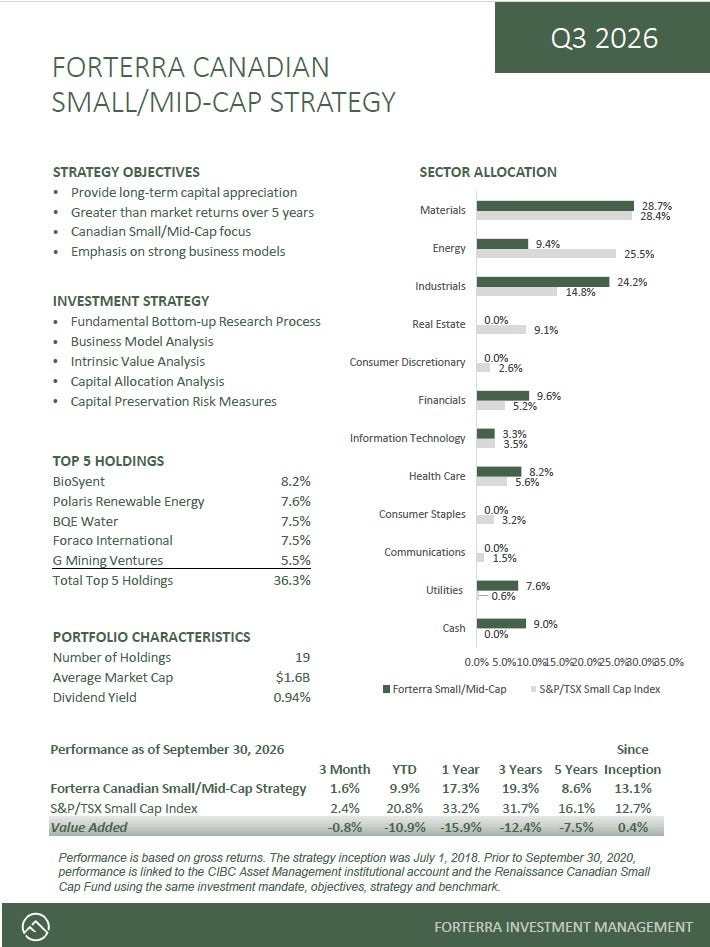
The Forterra Canadian Small/Mid-Cap portfolio returned 1.6% gross of fees in Q3 2026, against a 2.4% gain for the S&P/TSX Small Cap Index.
It was a busy quarter. We added three new companies to the portfolio and made several adjustments to existing positions. In Q2, we trimmed Foraco at prices above $3.15 per share to manage its size in the portfolio. In Q3, we added back to the position with the shares trading more than 25% lower. We will continue to take advantage of volatility, particularly when it is unrelated to the fundamentals of the business. We view Foraco as a best-in-breed driller with global growth opportunities, and we see a compelling long-term opportunity as the company reduces its debt and benefits from a strong resource cycle.
We also added to Zedcor. The shares have traded sideways despite management’s steady progress in growing the business. In our view, the market is being short-sighted in its focus on the absence of large orders. We believe the shares are increasingly mispriced and expect patience to be rewarded.
We modestly trimmed VersaBank after a run of more than 50% year-to-date, again to manage position size. We continue to see a long runway for growth as the company expands in the U.S. As more investors come to recognize its unique business model and high return potential, VersaBank has the makings of a long-term compounder.
We initiated a position in Metatek-Group, a resource services company that listed this spring. Since its initial public offering, the shares have fallen more than 40% on lower utilization of its survey equipment, mostly due to disruption caused by the war in Iran. We explain what Metatek does and why we see a compelling opportunity in this quarter’s Feature section.
We also initiated a small position in Goldsky Resources, a gold developer with projects in Sweden and Finland. It is our first investment in an early-stage, pre-production gold company since we bought G Mining Ventures in early 2022. There is a long list of ways a company at this stage can fail, so we tread carefully and size the position accordingly. What we like about Goldsky is its limited jurisdictional, regulatory and political risk. We also believe the geological, development, operational and financing risks are limited or manageable, although only time will tell. The flagship Barsele project offers growth potential, and the capital required to advance it is manageable. The team is experienced, well advised and backed by a well-aligned major shareholder in Agnico Eagle, which owns 32.5% of the company.
As G Mining Ventures and K92 Mining have performed, we have gradually scaled back both positions and used the proceeds to diversify into gold companies at different stages. Goldsky is our developer, Rio2 our junior producer and Elemental Royalty our diversified royalty company, while G Mining Ventures and K92 Mining remain growing intermediate producers with proven track records. Together, these holdings give us exposure to four producing mines and 21 producing royalties across gold, silver and copper. We continue to see a place for gold in the portfolio, particularly through companies that can create value beyond the price of the underlying metal. This approach lets us maintain diversified exposure to precious metals and copper through some of the industry’s best developers, operators, capital allocators and wealth builders.
Finally, we initiated a small position in a technology company. We are not commenting publicly on this holding yet, as we are still building the position across portfolios. With AI-related fears weighing on valuations across the sector, we are finding select opportunities in technology. We will have more to say about this company in a future commentary.
Performance Review
Our gold holdings were the strongest contributors to performance this quarter as the price of gold moved incrementally higher. K92 Mining was the standout, up 27%, followed by Rio2 (+19%), G Mining Ventures (+16%) and Elemental Royalty (+10%).
BioSyent rose 15% after a positive earnings report and growing investor recognition of the contribution from its recent acquisition of Oral Science. Firan Technology Group also contributed, up 10%.
On the negative side, Polaris Renewable Energy gave back some of its strong second-quarter gains, falling 11% as rising interest rates weighed on the utility sector. Champion Iron fell a further 22% as iron ore prices continued to soften and the strain on its balance sheet came into focus. We believe the company is trading well below its net asset value. We expect it to work through this period of weakness and emerge more resilient as it builds new markets for its recently commercialized high-purity iron ore.
Feature - Metatek-Group

MTEK-TSX | $2.70 | $133 million market cap
Metatek-Group (TSX: MTEK) is a geophysical services provider specializing in subsurface mapping for natural resource exploration.
Company Overview
Metatek-Group Ltd. (TSX: MTEK) maps what lies beneath the earth’s surface. Using specially modified aircraft fitted with gravity gradiometers built by Lockheed Martin, the company helps governments and resource companies locate oil and gas, critical minerals, geothermal energy, helium and hydrogen before they commit capital to drilling or seismic programs.
Metatek is headquartered in Milton Keynes, England, and incorporated in Alberta. It listed on the Toronto Stock Exchange in March 2026, raising C$35 million at C$5.00 per share. The organisation is lean, with 21 employees in the UK supported by 17 international consultants and offices in Egypt and Japan.
Its customers are mostly nation states. Energy and natural resources ministries, national oil companies and geological surveys account for more than 90% of the company’s backlog, with recent work in Nigeria, Angola, Egypt, Indonesia, Malaysia, Japan, Singapore, Azerbaijan, Colombia, the Philippines and North Africa.
History
Metatek began life in 2012 as Bridgeporth Ltd., founded by Dr. Mark Davies as a small firm processing and interpreting geophysical data collected by others. Client demand pulled it into collecting data itself, first on land and then from the air, with a focus on remote and logistically difficult regions.
The defining step came through Lockheed Martin. Full tensor gravity (FTG) gradiometry was developed during the Cold War to help US Navy submarines navigate without surfacing. Once declassified in the 1990s, it was adapted for resource exploration, but early airborne versions struggled with the vibration and noise of an aircraft. Dr. Davies and his team, who had worked with Lockheed for roughly a decade, developed the processing algorithms that made the instrument perform in flight. In return, Lockheed agreed to build and supply its newer generations of the system to Metatek for resource exploration, while retaining defence applications for itself.
A 2016 revenue-sharing agreement put the first of these instruments, the iFTG, into commercial service. Its successor, the enhanced eFTG, was delivered in 2019 and made its debut in 2020 on a 120,000 km² survey of Egypt’s Western Desert, completed in 33 days. Since then, the business has shifted decisively from private oil and gas companies towards governments.
In late 2021, PillarFour Capital led an equity financing that funded the eFTG purchase and a new digital instrument, the dFTG. The current holding company was incorporated in Alberta in 2023 and acquired Bridgeporth through a share exchange, with a view to a Canadian listing. Metatek bought the eFTG outright in 2024, doubled revenue in 2025 on the back of that single instrument, and completed its initial public offering in March 2026, with shares beginning to trade on the TSX on March 19 at $5/share.
More recently, the company struggled to fully utilize its instruments as the war in Iran caused planned survey work in Dubai to be halted. This disruption led to challenging results for the first half of 2026, causing the shares to fall into the $3 range, creating a compelling investment opportunity.
In October 2026, Metatek ordered a new eFTG from Lockheed Martin and secured seven years of global exclusivity on new eFTG systems. Three weeks later, it signed a long-term agreement with Bridger Aerospace for three dedicated survey aircraft.
What They Do
Metatek measures tiny variations in the earth’s gravity to build a three-dimensional picture of what sits underground. Rock formations, salt bodies, sedimentary basins and ore deposits all differ in density, and those differences subtly bend the local gravity field. A conventional gravity meter records only the vertical pull at a single point. Metatek’s full tensor gradiometers measure how gravity changes in every direction at once, which allows the edges and shapes of buried structures to be mapped at depths beyond 10 kilometres.
The practical value lies in speed and cost. Seismic surveys remain the gold standard for detail, but onshore crews cover only 3 to 6 line kilometres a day and the work is expensive and invasive. An airborne gradiometry survey can cover several hundred line kilometres a day at a fraction of the cost. Metatek does not replace seismic; it tells clients where seismic and drilling are worth doing. Other sensors, including magnetics and LiDAR, fly on the same aircraft, so several datasets are gathered in a single campaign.
How the business makes money
Almost all revenue comes from Integrated Acquisition Projects. Metatek plans the survey, flies it over roughly two months, then processes and interprets the data in the UK over a further three to four months. Results are delivered through its GeoVault software platform, together with training for the client’s own staff. Metatek also flies conventional gravity and magnetic surveys, which do not tie up its gradiometers. A North African contract is due to start in the fourth quarter of 2026, and management expects one or two such projects a year.
Pricing is quoted per line kilometre, but management effectively sells instrument time. Each system is expected to generate US$20 to US$25 million of revenue a year at around 70% utilisation, against a capital cost of roughly US$25 million including the aircraft. Growth is therefore largely a question of how many instruments Metatek has in the air.
The fleet
• eFTG: the flagship instrument, in commercial use since 2020, with four to eight times the signal quality of older systems. It flew in Japan in the third quarter and moves to the Philippines in the fourth.
• dFTG: a lighter digital version that can be mounted on helicopters. Its first deployment in Dubai was disrupted by the war in Iran, and it has since surveyed in Azerbaijan before moving to West Africa.
• iFTG: the original instrument, being refurbished by Lockheed for marine surveys, with work expected to finish in 2026, with the instrument planned to deploy in Q1 2027.
• New eFTG: ordered in October 2026, with a build time of about three years. Metatek holds an option on one more at preferential pricing.
Metatek is the only operator of the latest three generations of the technology. Its two principal competitors, Bell Geospace and Xcalibur Smart Mapping, fly earlier systems.
The aircraft
An instrument earns money only while it is flying. Metatek owns a DC-3 and a Twin Otter and leases other aircraft as projects require. Under the Bridger agreement, Bridger will modify, operate and maintain three Basler BT-67 aircraft dedicated to Metatek, each on a five-year term with an automatic five-year extension. The first is expected to enter service in 2027.
The BT-67s are equipped for cold-weather work, opening markets Metatek could not previously serve. The arrangement also spares Metatek the capital and overhead of building a larger aviation operation in-house. Management says it supports the company’s target of 70% instrument utilisation.
Investment Case
In Demand
Metatek’s backlog has grown from below US$50 million before the IPO to US$89 million at the end of June, nearly four times 2025 revenue. We see three main drivers behind this demand.
The first is energy security. When conflict in the Middle East all but closed the Strait of Hormuz this spring, governments quickly realized how vulnerable they were to supply shocks. In a more protectionist and conflict-prone world, energy will remain a heightened concern for many countries. Almost three-quarters of the world’s population lives in countries that are net importers of fossil fuels.
The second is electrification. Global electricity demand is expected to keep growing, driven by industry, electric vehicles, data centres and cooling. The International Energy Agency forecasts a structural copper deficit of 25% through 2035. Governments want to know whether they have untapped resources within their own borders.
The third is critical minerals. China mines roughly 70% of the world’s rare earths and processes up to 90%. When it began imposing export controls in 2025, it was a wake-up call for industry and governments alike. Several rare earths are essential inputs to defence supply chains, and these minerals are now strategic assets.
We believe nation states will increasingly need to understand their resource potential to meet their energy needs, electrification demands and critical mineral requirements. Metatek’s value proposition, the ability to survey large areas quickly with advanced technology, should keep its services in high demand.
A Decade-Long Head Start
Metatek’s technological moat rests on its relationship with Lockheed Martin, the sole manufacturer of these instruments. The October agreement grants Metatek seven years of global exclusivity on new eFTG systems, extending to nine if it exercises its option on a further instrument. Since each system takes about three years to build, we do not expect a competitor to field a comparable instrument until well into the next decade.
The closest competitors fly older technology. Houston-based Bell Geospace operates the Air-FTG, an instrument introduced in 2001. Madrid-based Xcalibur Smart Mapping runs six Falcon systems, originally developed by Lockheed with BHP. Metatek does not win on capacity. It wins on resolution, with the eFTG delivering four to eight times the signal quality of earlier systems. Its recent Philippines award shows this in practice: Metatek was not the lowest bidder, but won on technology.
Seismic surveys do not compete directly. They provide more detail over a much smaller area, at far greater cost and a far slower pace. Metatek’s surveys tell clients where seismic and drilling are worth doing. A good gravity survey reduces wasted seismic spending rather than replacing it.
Growth Already in the Hangar
2026 has been a frustrating year operationally. The dFTG’s first deployment in Dubai was disrupted by regional hostilities, weather delayed other projects, and first-half revenue was just US$6.9 million. Management still guides to US$28 to US$32 million for the full year, implying a much stronger second half.
2027 should be the first year in which Metatek has three instruments in service. The eFTG and dFTG should work a full year, and the refurbished iFTG is expected to return in early 2027 for marine surveys. Three prospective clients have expressed interest in the iFTG, although no contracts have yet been signed. Management estimates that each instrument can generate US$20 to US$25 million a year at around 70% utilisation. The first Bridger aircraft, also due in 2027, should help push utilisation towards that target. We forecast 2027 revenue of approximately US$60 million, up nearly 100% on 2026.
Further out, the new eFTG is expected in late 2029, and Metatek holds an option on one more. Much of Metatek’s growth depends less on finding new customers than on putting more instruments to work.
Optionality
Beyond its core instruments, Metatek has two further avenues for growth that are not yet material to revenue. Both build on capabilities and client relationships the company already has.
From Delivery Tool to Data Platform
Metatek delivers its survey results through GeoVault, its proprietary software platform. Today, GeoVault is the secure portal through which clients receive their data, maps and models. Standalone processing and interpretation, where Metatek works on client’s existing data, accounts for less than 2% of revenue.
The opportunity lies in data governments already own. Many have spent decades building libraries of seismic and well data, much of it in older 2D formats. Combined with Metatek’s gravity data, these records can be turned into three-dimensional models of the subsurface. In Egypt, the petroleum ministry had spent more than US$75 million on seismic and well data that proved misaligned before Metatek’s survey.
Management intends to launch upgrades to GeoVault by early 2027 that will let users interrogate stored data and carry out basic processing and interpretation themselves. Access would be sold on a subscription basis, alongside post-project licensing and long-term data hosting. Results could reach clients within days or weeks, compared with up to 12 months for legacy systems. GeoVault is not marketed as a standalone platform today, but we can see a future in which it becomes a meaningful source of high-margin, recurring revenue.
Beyond the Gradiometer
Metatek’s expertise extends well beyond its Lockheed instruments. It already flies conventional gravity, magnetics and LiDAR, carries out ground-based magnetotelluric surveys, and manages broader geophysical programmes for clients. The recent North African contract uses conventional gravity and magnetics alone, and management expects one or two such projects a year.
This work generates revenue without relying on the availability of the FTG instruments. It also opens markets Metatek could not otherwise reach. Lockheed’s gradiometers are subject to US export controls, and Metatek needs approval from Lockheed and the US State Department to operate them in new countries. At the same time, some governments may prefer not to have US military-grade technology flying over their territory. Conventional instruments let Metatek serve these clients and build relationships that may later lead to gradiometry work.
The marine environment offers further room to grow. Alongside the refurbished iFTG, which will survey from leased local vessels, Metatek is evaluating smaller instruments for drones and underwater vehicles. These could reach near-shore and complex seabed settings where current methods struggle.
Each of these services draws on the same scientists, processing software and client relationships. They generate revenue outside the core instruments while staying firmly within Metatek’s wheelhouse.
Risks
Sole supplier. Metatek depends entirely on Lockheed Martin, not only for new instruments but also for repairs, maintenance and refurbishment. Lockheed’s priority is defence, and Metatek is a small customer by comparison. If Lockheed shifted its production or service capacity elsewhere, Metatek’s instruments could sit idle or new ones could arrive late. The relationship spans well over a decade and has served both parties well, but it remains the company’s single largest dependency.
Operational. The business depends on keeping a small number of instruments busy. An aircraft accident, damage to an instrument or extended weather delays would hit revenue directly. With only two instruments flying today, each one is vital. That concentration should ease as the fleet grows, but it will not disappear.
Geopolitical. Metatek works in many countries where conditions can change quickly. In 2026, regional hostilities disrupted the dFTG’s first deployment in Dubai and contributed to a weak first half. Entering a new country also brings permitting and mobilisation delays that can push revenue from one quarter into the next.
Customer concentration and collection. A handful of large government contracts drive Metatek’s results. Its four largest customers accounted for 87% of 2025 revenue. Sovereign clients can be slow to pay, and a delayed payment or cancelled contract would have an outsized effect on a company of this size.
Financial. We believe Metatek can fund its committed instruments from its balance sheet and future cash flow, but this is not guaranteed. The Bridger agreement reduces the capital needed for aircraft but adds fixed monthly fees, payable whether or not the instruments are working. Project delays or low utilisation would make these commitments harder to meet and could require new equity or debt.
Competition. Exclusivity protects Metatek from rivals buying the same instruments, but not from a competitor developing something better. Our research suggests Metatek’s technological lead is secure today. However, with the help of AI, technology may advance faster than it has in the past. We will watch this closely.
Valuation
Metatek’s operational setbacks in the first half of 2026 have left its shares more than 40% below the C$5.00 IPO price. That decline caught our attention and, in our view, created an exceptional valuation opportunity.
In our base case, Metatek trades at just over 3x 2027 EV/EBITDA. We assume the eFTG and dFTG together contribute US$45 million of revenue in 2027, the midpoint of management’s original estimate of US$20 to US$25 million per instrument. We assume a further US$15 million from the iFTG and other services, allowing time for the iFTG to launch in early 2027 and ramp up its utilisation.
The table below sets out our forecast to 2030. It assumes the iFTG enters service in 2027, the new eFTG enters service in 2030, and the fleet reaches its target utilisation of around 70% over the period. On these assumptions, revenue grows at a compound annual rate of 31% and adjusted EBITDA at 35% between 2025 and 2030.

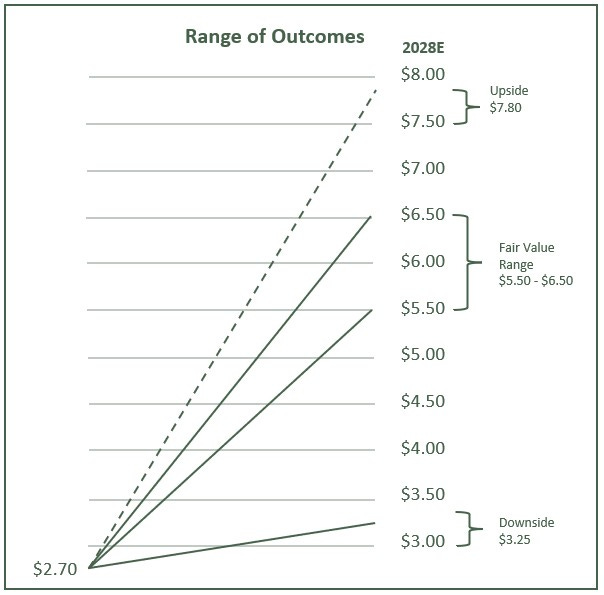
The chart below shows how we think about the asymmetry. Our base case points to a fair value of C$5.50 to C$6.50 per share, using a conservative multiple of 6x to 7x 2028E EV/EBITDA. If Metatek executes well in 2027, we believe even 7x will prove conservative, and a multiple closer to 8.5x would take the shares towards our upside case of C$7.80.
In a period of inconsistent execution and lower utilisation, the shares could trade closer to 4x EV/EBITDA, or about C$3.25. More severe operational problems would take them lower still.
Final Thoughts
Metatek is a good example of the inefficiencies in the small-cap market. At its C$5.00 IPO price, the shares may have been close to fair value given their near-term prospects. After an operational setback, however, a limited trading history has worked against the company. With few institutional investors on the register and thin trading, fewer long-term, fundamental investors are setting the price.
We believe that as management delivers more consistent execution, the market will take notice. Companies capable of compounding EBITDA at 35% a year for five years do not stay overlooked for long. Metatek fits squarely with our search for growing businesses at attractive prices, and at today’s price, we believe it is a bargain.
We also value that demand for Metatek’s services is not tied directly to commodity prices. It rests instead on energy security and access to critical minerals, which we see as more durable and structural. Governments are looking beyond the commodity cycle to understand the resources they will need for decades to come.
In a world where the cost of everything keeps rising, knowing what lies under the surface has rarely been more valuable. Metatek is the only company flying the latest generation of instruments that can bring this underground wealth into view, and the market has yet to price that in. We are content to be patient while it does.
Forterra Investment Management Inc. is registered as a portfolio manager with the Ontario Securities Commission and the British Columbia Securities Commission. This commentary is for information only. It is general in nature, reflects the author's views as of the date of publication, and is not investment, financial, legal, or tax advice, nor a recommendation or solicitation to buy or sell any security. Any companies or securities mentioned are used to illustrate the author's thinking, and Forterra and the accounts it manages may hold positions in them, which can change without notice. Investing involves risk, including the possible loss of capital, and past performance does not guarantee future results. Full disclosures are available on the About page.