
Summary
Introduction – Being Different is Good
We are different by design. Where we look, why larger managers cannot follow us there, and what that freedom lets us do.
Market Commentary - Does Valuation Matter?
From the Concorde to nuclear fusion to the largest IPO in history: why we leave the hardest puzzles to someone else.Portfolio Review
A review of key portfolio changes during the quarter, including new investments, trims, and exits.Performance Review
An overview of the companies that most influenced portfolio performance this quarter, both positively and negatively.Feature – BioSyent
No longer a one-trick pony: how recent transactions gave BioSyent more ways to win.Factsheet
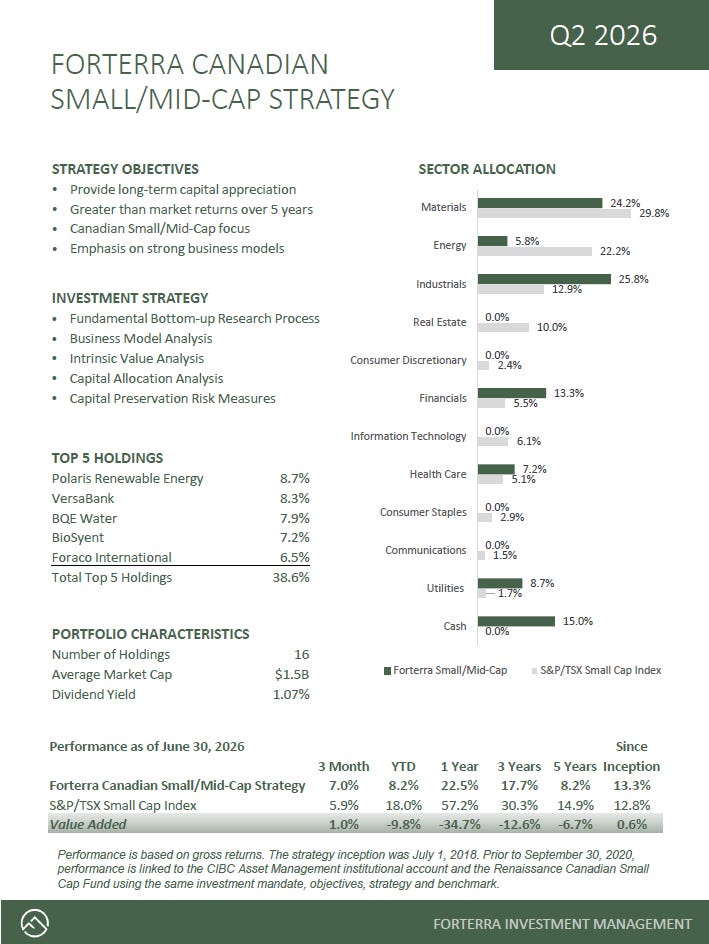
A concise snapshot of the portfolio, including sector exposure, top holdings, and historical performance.
Introduction
Being Different is Good

When I describe what we do at Forterra, I often find the simplest explanation is what we don’t do. We don’t hug benchmarks. We don’t gather assets. We don’t run our decisions through committees. We are different by design, and I want to use this introduction to explain how and why.
Where we look
Our edge starts with where we spend our time. We look at smaller and less liquid companies, the parts of the market that most professional investors cannot touch. A portfolio manager running billions simply cannot build a meaningful position in a company like BQE Water or Atlas Engineered Products. Even if they love the business, the math doesn’t work. The same was true when we first bought positions in Foraco, Firan Technology Group and VersaBank. These companies were too small, too thinly traded, or too unloved to matter to the big players. That is exactly why they mattered to us.
In a truly Canadian analogy, it is a bit like beachcombing, a reference that will land differently depending on your age. For those who grew up on the CBC series The Beachcombers, you’ll remember Nick Adonidas making a living pulling logs out of the water that everyone else had missed. That is not far from what we do. Some companies have just surfaced on the market, and we are among the first investors to look at them closely. Others have been around for a long time but sit overlooked, often because they are too small, too hard to see clearly, or require a different perspective altogether to be understood.
Why the big firms can’t follow
It isn’t just liquidity that keeps larger managers away. It’s incentives.
Most portfolio managers at large firms have to think about their careers. They can’t afford mistakes that would look foolish in retrospect, so they avoid positions that carry that risk, regardless of the potential return. They are compensated on shorter-term performance, so an investment that pays off in years two, three and four of the thesis is often too far out. They can hold a few of these, but not many. And they are managing other people’s money at arm’s length, judged by committees against benchmarks and arbitrary measures of volatility. None of this is a criticism of the people. It is a description of the system, and the system creates incentives that are not always aligned with long-term returns. I spent years inside one of the big banks. The conflicts and complexities are hard to appreciate unless you have seen how the sausage is made.
What our freedom lets us do
Because we are built differently, we can do things the big firms cannot.
We can be patient. We first invested in Polaris Renewable Energy over seven years ago. It always looked asymmetric to us, and we added to the position near the bottom. Now that the thesis is starting to work, we can see a path for the shares to double over the next couple of years. Add in the high dividend collected along the way, and the full-cycle return in that scenario would be very good. That kind of holding period is simply unavailable to a manager measured quarter to quarter.
We can be willing to look a bit stupid. Buying Firan Technology Group at $11 felt uncomfortable. It was trading at $3 per share just two years prior, having an extraordinary run up to $11. It was trading at a historically high valuation for the company. Despite our research pointing to a continued runway for growth – it wasn’t comfortable. The shares could have pulled back materially on any operational setback. Our contrarian position in Atlas Engineered Products still feels uncomfortable at times. We manage that discomfort through position sizing and looking out further on the horizon. We are also not afraid to let cash build in the portfolio when opportunities are scarce. That can also look like a mistake, but we care more about being deliberate in allocating capital. Nobody enjoys looking wrong, but it doesn’t guide our decisions. Our decisions are based on the research we have at the time. Do this long enough and you learn that almost anything can look brilliant or stupid in retrospect. There are no extra points for complexity or for looking smart. We judge ourselves against long-term performance and nothing else.
And we can think in terms of individual businesses rather than the whole market. Our thinking is rarely a call on where markets are headed. It is usually about the valuation of specific companies on our watchlist.
One clarification, since our strategy name and focus are so Canadian. We concentrate on smaller Canadian companies because we get good access to management teams here, but nothing prevents us from buying businesses domiciled or traded elsewhere. One of our best investments of the last five years was a US-listed company, Cellebrite, and our watchlist includes many others. It is also worth noting that most of our Canadian-listed holdings conduct some, if not most, of their business outside Canada. We look through the labels and analyse the business in every market it operates. We are not taking regional exposure so much as finding underappreciated long-term investments wherever they happen to trade.
What this means for you
Our philosophy is built from first principles: long-term returns while guarding against permanent loss of capital. Not benchmarks, not volatility scores.
We are aligned with you because we are invested alongside you. I am managing other people’s money, but I am also managing my own money and money for my family and friends. I don’t carry the same career risk as a bank employee, and I don’t answer to a committee. We think about absolute returns more than relative ones, which frees us from worrying about what the index looks like in any given quarter.
We are not a traditional investment advisor, at least not in the way those practices are commonly built. There are no sales targets and no commissions. We take on a limited number of new private clients each year, and only those who are a good fit for our model. Many of our clients hire us as specialists, responsible for the long-term growth portion of a larger portfolio. These are often wealthy families with other advisors, family offices, or individuals who do most of their own investing in real estate or private companies but want a specialist for public equities. It is no coincidence that many of our clients are entrepreneurs. They recognize alignment when they see it.
We don’t do business with committees. We work with people. And we bring in outside experts where clients need specialized advice on estate planning, tax or legal matters, which keeps us focused on what we do best.
Why I do this
This work feeds my natural curiosity. I think curiosity is a requirement in this role, a genuine desire to constantly learn and understand new things. It is both the challenge and the reward, a cycle that keeps us connected to what is changing in the world. While I spend my days helping others find security in their retirement, I have no intention of retiring. Forterra was built with the flexibility to grow slowly, give proper attention to our investors, and let us keep doing what we love.
We recently updated our website to reflect more accurately what we do for investors who hire us as specialists and what we do for private clients. We think it better explains how we work and what makes us different.
Because we think being different is good.
-Robert
*you can check out our website here: www.forterrainvest.com
Market Commentary
Does Valuation Matter?
It is an age-old question, and one asked more often when investors are confronted with disruptive technologies. The second quarter delivered a vivid example. On June 12, SpaceX completed the largest initial public offering in history, raising roughly $75 billion at a valuation near $1.75 trillion.
Staunch value investors argue that valuation always matters, and that it simply gets ignored for stretches when enthusiasm runs high. The bright lights blind us to near-term risks as we cast our gaze into a rose-coloured future. Savvy growth investors point instead to the rewards reaped by the early backers of Amazon and Google, and argue that getting in early on a long-term trend matters far more than trying to value a company with that much potential.
Both things can be true at once. Valuation is important, and it is a key determinant of investing success for most investments, most of the time. For a small number of investments it has proven less useful, and what matters more is the size of the addressable market, the growth trajectory, or the nature of the disruption itself.
What we have learned over the decades is that disruptive technologies are very hard to value.
Consider the Concorde. It launched in 1976 to enormous fanfare, hailed as the plane of the future, cruising at Mach 2 and cutting London to New York to roughly three hours. The technology worked exactly as promised, and it flew for 27 years. But instead of supersonic travel fundamentally changing aviation, it was relegated to a niche corner of the industry. It fell far short of the projected 350 aircraft anticipated to enter the market, with only 14 entering service. The program never earned back what it cost to create. It burned enormous quantities of fuel, and sonic boom restrictions confined supersonic flight to routes over water, leaving few city pairs able to support its fares. Speed, it turned out, was not the innovation that mattered. The advances that reshaped aviation came in fuel efficiency and cost.
The Concorde is not alone. Some technologies never arrive at all, and nuclear fusion has been perpetually twenty years away since the 1950s. Others arrive in a far smaller form than promised. The Segway was going to reshape how cities were built and became a novelty instead. 3D printing is genuinely useful, but it has not replaced the factory. Blockchain, conceived in 1991 and given commercial life by Bitcoin in 2008, was supposed to transform enterprise transactions in trade finance and logistics. Dozens of Fortune 500 companies and global banks funded pilots in 2017 and 2018. Most were shelved.
Even when a technology works as designed, judging its commercial success is difficult. Valuing it is harder still.
We look for easier puzzles
We do not try to solve the hardest ones. There is ample reward in companies that are growing steadily and whose value is simply under-appreciated. Here, valuation does the work.
We aim to understand the range of outcomes for a business, discount its future cash flows, and test the result against the multiples at which comparable companies trade and transact. We treat fair value as a range rather than a single price, and cheapness on its own rarely interests us.
SpaceX’s valuation may be out of this world, but we do not need to solve for it. It is a data point on investor enthusiasm and on where we sit in the cycle, nothing more. If anything, it works in our favour. Every dollar of attention drawn toward the frontier is a dollar not spent examining the companies compounding value elsewhere.
The market will eventually settle the question of what the frontier is worth, and it may well take a decade or more to do so, as it did with supersonic flight and as it is still doing with fusion. We are not waiting for that answer. We are content to work where the spotlight is not pointed, on businesses whose value we can actually assess and underwrite today.
Portfolio Review
The Forterra Canadian Small/Mid-Cap portfolio returned 7.0% gross of fees in Q2 2026, against a 5.9% gain for the S&P/TSX Small Cap Index.
Activity in the second quarter consisted mostly of trimming and adding to existing positions, the exception being our exit from Magna Mining. We sold the position in April after it became clear to us that the company would not be able to expand the McCreedy West mine and restart the Levack mine without a significant injection of cash. Our thesis was that Magna would generate cash from operations to fund its growth, and this never materialized.
In May, we trimmed Foraco, the global contract driller for the mining industry, to manage the position size. The shares had nearly doubled since we significantly added to the position in June and July of last year. With the shares trading at less than 8x our estimate of 2027 earnings per share, and its larger peer Major Drilling trading closer to 15x earnings over the same period, we see room for a valuation re-rate if Foraco can demonstrate that higher utilization is translating into earnings growth. Even without the relative comparison, we see a potential free cash flow yield of greater than 20% in 2027 with successful execution. Over this period, we expect Foraco to significantly de-leverage its balance sheet and add to its fleet in regions where it continues to win new work, such as the U.S. and South America.
Also in May, we added to the starter position in healthcare company BioSyent that we initiated in March. We see the potential for this unique company to compound over the long term. You can read more about our view on BioSyent in our feature section.
We trimmed the position in Firan Technology Group in May after a very strong run in the shares. We continue to see strong long-term value in FTG, but we also recognize that the upside from the $25 per share range is more limited than it was when we initiated the position in the $11 range in July and August of last year. FTG has many tailwinds, with both its aerospace and defence end markets showing strength. The company recently opened its new facility in India, adding capacity to its global manufacturing network, and could also make an acquisition in Europe to better position itself to benefit from the structural shift in defence spending in that market.
Performance Review
The largest contributor to performance was VersaBank, up 66%. Strong results in both the Canadian and U.S. core businesses continued to reinforce management’s growth targets. The company also made progress on the real-time funding enhancement for its structured receivable program, which it believes will open up new partnerships.
Polaris Renewable Energy also performed well, up 25%. The company received final approval for its battery energy storage project in Puerto Rico, and announced that all three of its projects submitted for mixed development in Mexico were selected to advance to final contract negotiations. This would be a significant step-up in growth for Polaris and could double its power generation capacity by 2029.
Firan Technology Group, up 22%, and Zedcor, up 18%, also contributed to performance.
Champion Iron fell 24% on softness in the price of iron ore, mixed operational results and a change in dividend policy that caught some investors off guard.
As the price of gold slipped, some of the gold companies gave back recent gains: G Mining Ventures fell 15%, K92 Mining 6% and Elemental Royalty 5%.
Feature - BioSyent

RX-TSXV | $14.50 | $167 million market cap
More Ways to Win
BioSyent is a Canadian specialty pharmaceutical company that sources, in-licenses and commercializes niche healthcare products, and which recently diversified into oral health through the acquisition of Oral Science.
Company Overview
BioSyent does not discover drugs. It licenses them, which means the business carries no research risk and no patent cliff, and turns almost entirely on commercial execution. Through its BioSyent Pharma subsidiary, the company identifies underserved therapeutic niches, in-licenses or acquires products with genuine clinical differentiation, and commercializes them through a small, focused Canadian sales force. The formula has now produced 63 consecutive profitable quarters.
The business has historically rested on a single pillar. FeraMAX has been Canada’s leading recommended iron supplement for the eleventh consecutive year, and until recently it accounted for roughly 70% of revenue. That concentration has changed materially over the past 18 months. BioSyent has launched Thyconvi, a new liquid endocrinology product, and in March 2026 closed its largest acquisition to date, paying $25.5 million for Oral Science, a Canadian dental hygiene distributor. FeraMAX now represents closer to 40% of revenue. This is a more diversified and more resilient business than it was even two years ago.
History
BioSyent traces its roots to Hedley Technologies, a legacy biological insecticide business that still contributes modest and lumpy revenue today. The company renamed itself BioSyent in 2006 to reflect its pivot toward pharmaceuticals, and has since built a business focused largely on women’s health, selling into pharmacies, hospitals and specialists, primarily in Canada.
In September 2024, BioSyent paid roughly $4.4 million for global distribution rights to Tibella and Tibelia (tibolone), a hormone replacement therapy already growing at more than 30% annually in Canada. Three months earlier, it had signed a licence agreement for a European-partnered endocrinology asset at an upfront fee of just EUR 50,000. That asset has since become Thyconvi. Management has described it as one of the company’s most asymmetric bets, with negligible capital at risk against a product addressing hypothyroidism, one of Canada’s largest chronic prescription categories.
With Oral Science acquired in March 2026 and Health Canada approval of Thyconvi granted in May 2026, the company has added oral care and endocrinology as genuine new avenues for growth.
What They Do
Pharmaceutical sales, Canadian and international. FeraMAX remains the core, alongside Tibella in Canadian hormone replacement therapy and Tibelia in international distribution, plus a handful of smaller specialty and community health brands. This segment generated $40.9 million of sales in 2025, or 95% of the total.
Oral health. Oral Science distributes dental hygiene products into more than 6,000 Canadian dental clinics, close to 40% of the clinics in the country, as well as through retail pharmacy and direct-to-consumer channels. Roughly a third of its revenue comes from proprietary products and the balance from exclusive distribution agreements with international partners. Oral Science generated approximately $31.2 million of revenue in 2025 and has compounded at 15% historically.
Thyconvi. A newly launched oral liquid formulation of levothyroxine, the standard treatment for hypothyroidism. Levothyroxine tablets have been available generically for decades, but no liquid alternative has existed in Canada. That is a real gap for patients with swallowing difficulties, for paediatric patients, and for anyone whose absorption issues make consistent tablet dosing unreliable.
Legacy business. A small, non-core insecticide operation that we treat as a residual cash flow stream.
Investment Case
Oral Science is a bigger near-term catalyst than the market has recognized
This may be the most underappreciated part of the current setup. Reported results to date include only a single month of Oral Science, namely $2.98 million of revenue in March 2026. Investors have not yet seen a full quarter inside BioSyent’s numbers, let alone a full year.
Management has guided to roughly $30 million of Oral Science revenue over the ten months of 2026 ownership, and our base case assumes 10% to 12% organic growth over the next several years. That growth should come from continued penetration of categories such as air polishers, which remain early in their adoption curve in Canadian clinics, alongside a broader push into dental service organizations. BioSyent paid 6.3 times trailing twelve-month EBITDA, and less than five times after adjusting for working capital, a highly accretive multiple for a quality business growing at double digits.
Thyconvi is conservatively underwritten
Thyconvi has cleared Health Canada and moved into commercial launch, and BioSyent is now filing for private insurance reimbursement on a wide-open label. Notably, management’s base business case assumes no contribution at all from provincial reimbursement, on the view that the discount required to win formulary listing would be too steep to be economically attractive. The plan is built entirely around the private-pay opportunity.
Management has guided to a $10 million peak-year sales target and cautions that reaching it could take more than five years. Our own work, cross-referencing IQVIA prescribing data against international liquid levothyroxine analogues, points to a wider plausible range of $5 million to $20 million. The core target populations are underserved today: patients with swallowing difficulties, who represent roughly 2.5% of the population and a larger group than most investors would guess, patients with fluctuating thyroid-stimulating hormone, and paediatric patients. We do not believe the market is giving BioSyent any credit for what Thyconvi can contribute over the next three to five years.
Capital allocation is disciplined and shareholder-friendly
BioSyent continues to raise its dividend and repurchase stock even while absorbing the Oral Science acquisition. With the balance sheet already building cash after the deal, management has signalled an acquisition opportunity set that now spans oral health and additional endocrinology assets alongside the traditional pharmaceutical base.
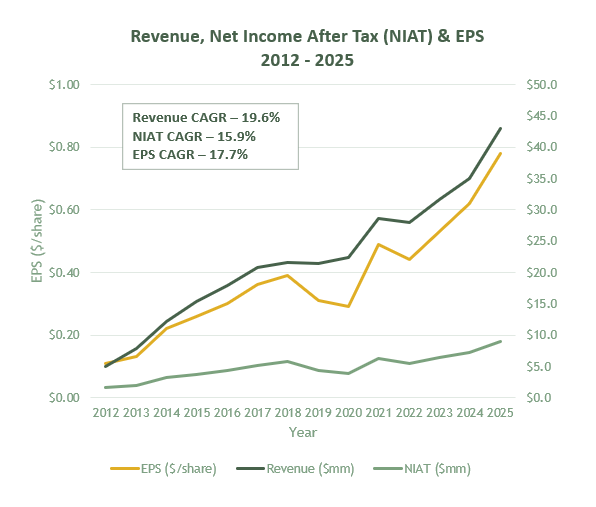
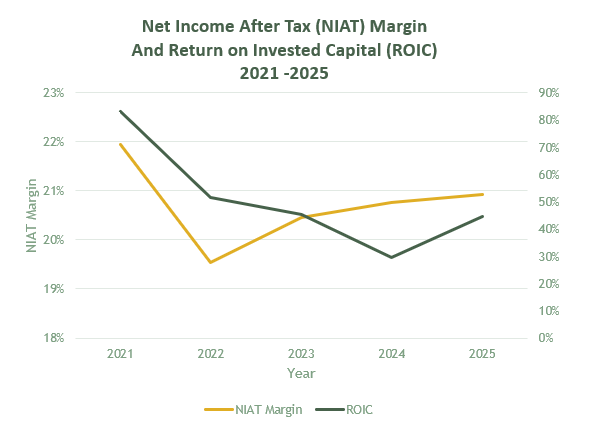
The track record supports the confidence. Over the past 14 years, revenue has compounded at 19.6%, net income after tax at 15.9% and earnings per share at 17.7%, all while the share count has fallen by 20%. Operating margins remain strong and return on invested capital is impressive. President and Chief Executive Officer René Goehrum owns roughly 20% of the shares. We think that alignment is a large part of why capital allocation has been this disciplined.
Optionality
PerioMonitor. Oral Science has developed a chairside gingivitis diagnostic that delivers results in minutes at a fraction of the cost of the lab-based swab-and-send alternative. The product has already secured approval in the United States, and management has confirmed it is actively seeking to out-license the product for markets outside Canada. The potential is genuinely hard to size today, which is precisely why Oral Science structured the sale to BioSyent to include a royalty on it. We understand the royalty is capped, and that margins remain very strong even after royalty payments. We would not be surprised to see a global out-licensing deal announced with a multinational partner within the next twelve months.
Thyconvi beyond the base case. Because the business case assumes no public reimbursement, any provincial formulary access is pure upside. So is any outcome toward the higher end of our $5 million to $20 million range.
Further acquisitions. Balance sheet capacity and management’s stated interest across both oral health and endocrinology make another acquisition plausible over our investment horizon, though we do not build one into our base case.
FeraMAX pipeline. Additional line extensions remain in development, including what we believe is an iron combination product, a natural extension of the existing women’s health franchise.
Risks
Accrufer competition. Accrufer (ferric maltol), launched by Kye Pharmaceuticals in early 2025, is the first and only prescription oral iron product in Canada. Prescription status is a structural advantage over FeraMAX’s classification as a natural health product, because it opens the door to provincial formulary and drug plan coverage that FeraMAX cannot access. Accrufer is off to a strong start. Based on our conversation with Kye management, it was running at roughly $5 million of annualized sales as of March 2026 and still growing, an impressive trajectory from a standing start. FeraMAX nonetheless continued to grow through 2025, and the evidence to date suggests Accrufer is drawing new patients rather than switchers. The overall iron market is expanding. Even so, this remains the single largest watch-point for our thesis.
Thyconvi execution. Reimbursement filings, physician adoption curves and peak sales timing are all unproven. Our $5 million to $20 million range is wide for a reason.
Oral Science integration and distribution dependency. This is a newly acquired business with its own key-person considerations around founder Daniel Ménard, and with distribution partner concentration. That includes its relationship with Curaden, which is working through a leadership transition following the death of its founder in mid-2025.
Liquidity and information asymmetry. BioSyent has coverage from a single sell-side analyst and thin average daily dollar volume. This cuts both ways. It is part of why we believe the opportunity exists at all, but it also means the shares can move sharply on light news flow, and that building or exiting a position of size requires patience.
Valuation
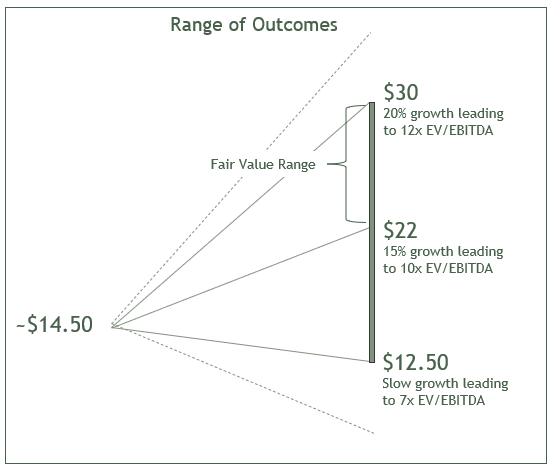
BioSyent trades at roughly 8.5 times our 2027 estimated EV/EBITDA, which we find attractive. Our base case has earnings per share compounding at 18% from 2025 to 2028 and adjusted EBITDA at 24% over the same period, with most of the increase coming from the addition of Oral Science.
Those figures rest on mid-single-digit growth in pharmaceutical sales, a modest contribution from Thyconvi in 2027 and 2028, and 12% growth in oral health. This requires strong execution, but it does not require anything exceptional. If the company delivers, we believe the business should be valued at 10 to 12 times EV/EBITDA.
The chart below shows how we think about the asymmetry. Our base case produces a fair value range of $22 to $30 per share depending on the growth rate and the multiple applied. The range is wide because it looks out three years, but the asymmetry is compelling given our view of the limited downside. Outsized success with Thyconvi, PerioMonitor or a further acquisition could push the outcome beyond the top end.
Final Thoughts
BioSyent is an owner-operator small cap with a strong record of capital allocation and operational execution. The market was not paying much attention to it while the story depended so heavily on FeraMAX, and we were in that camp for some time despite having the company on our watchlist. What the market is missing now is that this is no longer a one-trick pony. It has diversified, and the drivers of growth and the sources of optionality have both expanded.
The investment case will not play out in the short term. That is fine by us. We are content to be aligned with a management team that has meaningful skin in the game and a long record of creating value. An investor who bought BioSyent when René Goehrum took the helm in 1999 at roughly $0.20 per share would have made more than 72 times their money.
We believe a new era is beginning. This management team now has more ways to win across a larger portfolio. Oral Science is the company’s largest acquisition and arrives with a strong growth trajectory. Thyconvi is its highest-potential in-licensed prescription product to date. Neither is appreciated in the market today. Understanding all the moving parts of a larger business takes time, but we expect the results will eventually be hard to ignore.
We also like the resilience of the model. Whatever happens with international conflict, the oil price, inflation, consumer credit and trade wars, a business like BioSyent is largely insulated. The success driver here is execution, an area where this management team has a long and profitable track record.
Forterra Investment Management Inc. is registered as a portfolio manager with the Ontario Securities Commission and the British Columbia Securities Commission. This commentary is for information only. It is general in nature, reflects the author's views as of the date of publication, and is not investment, financial, legal, or tax advice, nor a recommendation or solicitation to buy or sell any security. Any companies or securities mentioned are used to illustrate the author's thinking, and Forterra and the accounts it manages may hold positions in them, which can change without notice. Investing involves risk, including the possible loss of capital, and past performance does not guarantee future results. Full disclosures are available on the About page.
Good write-up on Biosyent!